Jul 15, 2026
Modern Wine Cellar Design: Ideas, Styles, and What Sets the Best Ones Apart
Modern wine cellar design has moved well past the idea of a room built purely for storage. The cellars that define the category today are spaces where the collection is the architecture, where material choices are made with the same care as the rest of the home, and where the engineering that keeps wine in ideal condition is solved invisibly rather than announced. The result, when it is done well, is a room that feels like it belongs in the home rather than like a specialty addition grafted onto it.
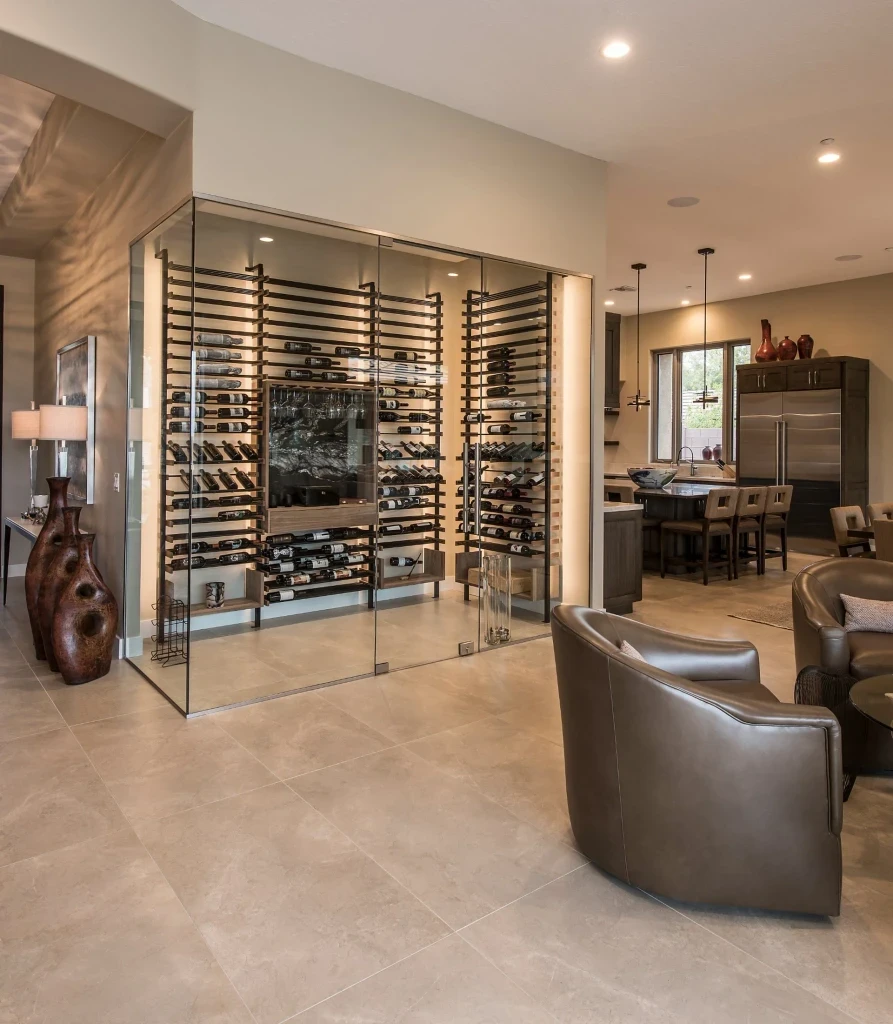
What Defines Modern Wine Cellar Design Today
What separates a genuinely modern wine cellar from one that simply uses contemporary finishes is the degree to which every decision serves the collection and the room simultaneously. The glass enclosure that lets bottles read as a living wall from the adjacent great room also needs to hold its climate conditions through the height of a Phoenix summer. The cable racking system that makes labels feel like a curated gallery installation also needs to be engineered for the weight and depth of the bottles it holds. The lighting that washes the bottles in warm, even light also needs to be specified for low heat output. In a well-executed modern wine cellar, none of these things are in tension with each other because the design process addresses them together from the start.
This guide covers the ideas, materials, and design directions that define modern wine cellar design right now, drawn from projects our team has completed for private residences, restaurants, and hospitality groups across the country.
The Core Ideas Behind Modern Wine Cellar Design
Glass Enclosures That Make the Collection Part of the Room
Nothing has shifted the direction of residential wine cellar design more dramatically over the past decade than the move toward glass enclosures. A glass cellar changes the relationship between the collection and the home entirely. Instead of being stored behind a wall, the wine becomes part of the visual fabric of the room it opens onto. From a great room, a kitchen, or a dining area, the cellar is always present, and the collection reads as an intentional part of the home's design language rather than as something hidden away.
The most compelling modern glass wine cellars treat the enclosure as a frame rather than a wall. Floor-to-ceiling glass panels with minimal framing hardware, full-height pivot doors, and perimeter lighting that illuminates the bottles from above and behind the racks rather than glaring through the glass all contribute to a result that is closer to gallery installation than to storage. The bottles themselves become the artwork.
For homeowners exploring this direction, the critical design decisions involve the framing system, the door specification, and the lighting strategy. Each of these choices has both an aesthetic and a performance dimension, and the best outcomes come from treating them together rather than solving them one at a time. You can see how this plays out across a range of projects in our contemporary wine cellar portfolio.
Cable and Acrylic Racking Systems
Cable suspension and acrylic peg racking systems are the material signature of modern wine cellar design, and the reason they have become so dominant is both visual and practical. These systems hold bottles with almost no visible hardware, which means the labels become the focal point rather than the racking itself. A wall of label-forward bottles on a cable system reads as a curated collection rather than as organized storage, and the visual effect scales in a way that traditional wood racking simply cannot match.
The design considerations worth understanding involve the back wall material, and the ceiling height. Cable racking reads best against a wall with visual texture and depth, whether that is concrete, dark steel, natural stone, or a richly finished wood. And ceiling height matters because the verticality of the system is where much of its visual impact comes from.
Integrated Wine Walls for Modern Homes
Not every modern wine cellar project involves a dedicated room. Wine walls integrated directly into living spaces have become one of the most requested design directions in residential projects, and the reason is straightforward: they bring the collection into the daily life of the home rather than keeping it separate from it. A wine wall in a kitchen, dining room, or living space turns the collection into a permanent feature of the room's architecture rather than a destination you walk to.
Modern wine walls work best when they are designed as part of the room's composition from the beginning rather than inserted into an existing wall after the fact. The relationship between the wine wall and the surrounding cabinetry, shelving, or architectural elements determines whether the result feels integrated or like an addition. For projects where the wine wall will be visible from multiple vantage points, the design has to read well from each of them.
You can explore a range of wine wall directions across our portfolio.
Material Palette: What Modern Wine Cellars Are Built From
The material palette of modern wine cellar design has converged around a set of finishes that share a few consistent qualities: they are visually rich without being ornate, they hold up well under cellar conditions, and they complement the label-forward display that most modern racking systems create.
Metal & Anodized Aluminum have become the structural material of choice for racking systems in modern cellars because they recede visually and let the bottles read forward. When the hardware disappears, the collection takes over. For the same reason, minimal framing on glass enclosures tends to use black metal rather than warmer tones.
Warm wood, used selectively, provides contrast against darker metals and stone that keeps modern cellars from reading as cold. White oak, and walnut are the species that appear most often, typically as accent walls, shelving, or framing elements rather than as the primary surface.
Modern Wine Cellar Design Ideas by Room Type
Modern Residential Wine Cellars
For private homes, the most compelling modern wine cellar designs share a quality that is harder to name than to recognize: they feel like they were designed for the specific home they are in rather than imported from a catalog. The glass enclosure that works in a modern open-plan great room may feel wrong in a home with a warmer, more traditional character.
The design process on residential projects starts with the home's architecture, the collection's character, and how the space will actually be used. A cellar that holds 500 bottles for a casual entertainer has different design priorities than a cellar that holds 3,000 bottles for a serious collector who wants every bottle accessible and legible. Getting those priorities right from the beginning is what produces a cellar that still feels correct ten years after it is built.
Modern Home Wine Cellar Ideas for Smaller Spaces
Modern wine cellar design is not exclusively the domain of large dedicated rooms. Some of the most visually striking residential projects we have completed occupy relatively compact footprints, because the modern design vocabulary, which prioritizes visual clarity, material precision, and the bottle as the focal point, actually scales down very well.
A compact glass-enclosed cellar visible from a living room or kitchen can hold several hundred bottles while functioning as one of the most distinctive design features in the home. A built-in wine wall in a dining room can hold a working collection while serving as the room's primary architectural element. A wine wall with glass doors and modern racking can transform an otherwise ordinary room into something genuinely memorable. The constraint of a smaller space often produces more inventive solutions than an unlimited footprint because it forces the design to be precise rather than expansive.
Modern Wine Rooms and Tasting Spaces
Some residential projects call for a cellar that functions as a destination room rather than just a storage environment. A modern wine room designed around a tasting table, or bar element creates a space that earns its place in the daily life of the home in a way that pure storage never can. These rooms integrate the cellar's functional storage walls with lounge seating, lighting that suits both display and gathering, and often a pouring station or bar setup that makes the space work for entertaining.
The design challenge in a wine room is achieving the balance between the storage function and the social function without compromising either one. Racking that reads as architectural backdrop, lighting designed for both display and ambient warmth, and furniture scaled to the room rather than borrowed from a general interior scheme all contribute to a result that genuinely functions as both.
Modern vs. Contemporary vs. Transitional: Understanding the Distinctions
A question that comes up often in design conversations is what actually separates modern wine cellars from contemporary or transitional ones. The distinctions are real, even if the terms are often used loosely.
Modern, in the design sense, refers to a vocabulary rooted in the modernist movement: clean lines, minimal ornamentation, and honest expression of materials. A modern wine cellar expresses structure plainly, uses materials for their intrinsic qualities rather than as decoration, and tends toward restraint.
Contemporary is a looser term that refers to what is current rather than to a specific set of design principles. A contemporary wine cellar might draw on modern elements while incorporating warmer or more organic materials that a strictly modernist approach would edit out. The category is defined by the moment rather than by ideology.
Transitional design sits intentionally between traditional and contemporary, combining the warmth and material richness of traditional design with the structural clarity and restraint of modern. A transitional wine cellar might pair stonework with glass enclosures and minimal hardware, creating a space that reads as timeless rather than period-specific.
For homeowners navigating these distinctions, the most useful question is usually not which label applies but which set of qualities fits the surrounding home. You can see examples of how each direction plays out in our contemporary, transitional, and traditional portfolio sections.
What to Look for in a Modern Wine Cellar Designer
The quality of the design process matters as much as the quality of the end result, and the two are not separable. A modern wine cellar designer who starts with the collection and the architecture before specifying any materials or systems will produce a different result than one who arrives with a preferred look and fits the project into it.
The questions worth asking in an early design conversation include how the designer approaches the relationship between the cellar's climate engineering and its aesthetic, how they handle the specific challenges of the home's location and architecture, and what their process is for translating a homeowner's priorities into a space that will still feel right years after it is built.
For homeowners and designers beginning this process, our team is happy to walk through the options that make sense for your project. You can view our portfolio of recent custom wine cellar projects, explore our products and racking systems, or request a project consultation to start the conversation.