Jun 16, 2026
Wine Cellar Doors: A Designer's Guide to Glass, Iron, and Custom Wood Options
Among the choices that define a custom wine cellar, the door is the one that gets underestimated most often. It is treated as the last detail when it is genuinely one of the first design decisions a cellar should resolve.
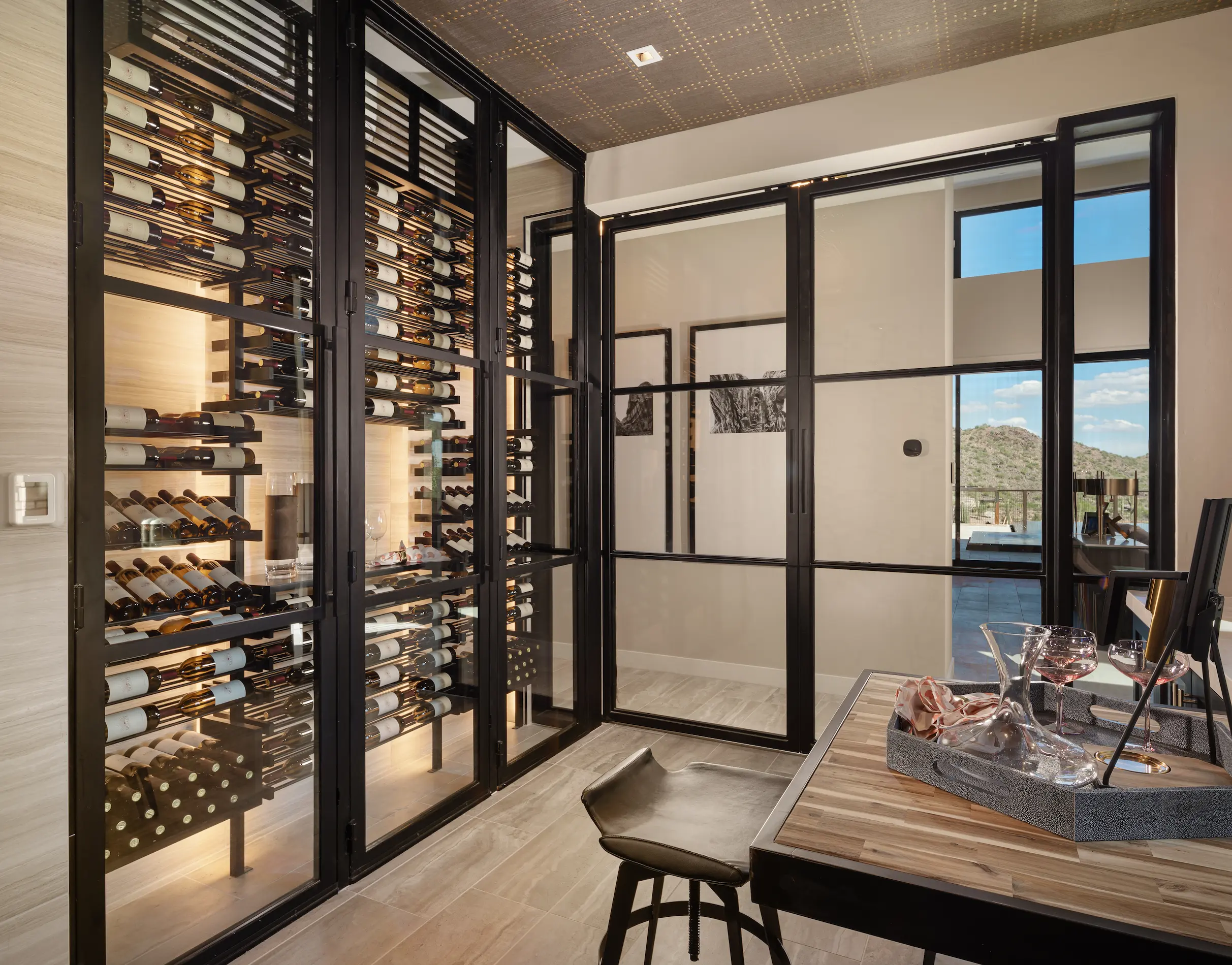
The Door Is the Decision That Sets the Tone for the Entire Cellar
Among the choices that define a custom wine cellar, the door is the one that gets underestimated most often. It is treated as the last detail when it is genuinely one of the first design decisions a cellar should resolve. The door is what guests encounter before they ever see the bottles. It establishes whether the cellar reads as architecture or as utility, whether it disappears into the room or commands it, and whether the climate engineering inside the cellar will hold up across a decade of use. Choose the wrong door, and even a flawless cellar feels off. Choose the right one, and the entire space gains a presence it would not otherwise have.
This guide walks through the wine cellar door options that come up most often in custom projects, the trade-offs that come with each, and the practical considerations that determine which choice will actually perform in your home or commercial space. The information here is drawn from the projects our team has built across residential, restaurant, and hospitality settings, and is intended to give homeowners, designers, and architects a working vocabulary for the door conversation.
What Does a Wine Cellar Door Actually Need to Do?
A wine cellar door has three jobs that have to be accomplished simultaneously, and the difficulty of doing all three together is what separates a properly engineered door from an ordinary interior door installed in a cellar opening.
The first job is sealing. The cellar holds conditions that are colder the surrounding home, and the door has to maintain that pressure differential without letting conditioned air leak out or warm air leak in. A door that fails this test will undermine the entire cellar's climate performance, force the cooling unit to work harder, and over time create condensation issues that damage adjacent finishes.
The second job is thermal isolation. The door is the largest single weak point in the cellar's insulation envelope. Solid wood doors with proper cores, insulated metal doors, and thermally engineered glass assemblies all handle this differently, and the right answer depends on the cellar's overall heat load and how aggressively the cooling system needs to manage it.
The third job is design. The door is the single most visible element of the cellar from outside the room, which means it carries an outsized share of the cellar's aesthetic identity. A door that solves the first two jobs perfectly but does the third one poorly will leave the homeowner regretting the choice every time they walk past it.
The custom wine cellar doors that succeed long term are the ones where all three jobs were considered together from the start, rather than where one job was prioritized and the others were accommodated afterward.
Glass Wine Cellar Doors: The Modern Standard
Glass doors have become the default direction for contemporary and transitional wine cellar projects, and the reason is straightforward. A glass door lets the collection participate in the visual life of the surrounding room, which means the cellar feels present even when the door is closed. The bottles read as part of the home rather than as something hidden behind a wall.
Among the variations homeowners ask about most often:
Full-height pivot doors offer the most architectural presence and work particularly well in cellars with significant ceiling height. The pivot mechanism allows a single panel to span openings that would require double doors in a hinged configuration, and the visual effect when the door swings open is closer to a gallery installation than to a residential entry.
Hinged glass doors with metal framing are the most common configuration for residential cellars. A well-detailed metal frame in a finish that matches the cellar's hardware and fixtures gives the door enough visual weight to anchor the room while keeping the glass as the dominant material.
For projects where the cellar is intended to be the visual centerpiece of the surrounding space, a glass door is almost always the right answer. You can see how this approach plays out in our contemporary wine cellar portfolio, where glass enclosures and doors are integrated into the overall room composition.
Wrought Iron Wine Cellar Doors: The Traditional Statement
Wrought iron wine cellar doors carry a design language that glass simply cannot replicate. The weight of the material, the visible craftsmanship of forged scrollwork, and the way iron ages over time all contribute to a door that suggests permanence and tradition. For homeowners building a cellar that draws on Old World references, or for projects where the architecture of the home calls for materials with genuine substance, iron is often the right answer.
The design range within wrought iron is broader than many homeowners expect. Hand-forged scrollwork suits traditional Mediterranean and European-influenced homes. Cleaner geometric ironwork suits transitional projects where the cellar bridges traditional and contemporary sensibilities. Minimal iron framing around large glass panels suits homes where the goal is to soften a strictly modern aesthetic with a single warmer material.
The performance considerations are honest. Iron is a less efficient thermal conductor than properly engineered glass assemblies, which means a wrought iron door requires careful detailing at the seal, and at any glass infill panels to maintain the cellar's climate performance. It also requires foam filling inside the tubing, The weight of iron also requires hardware and framing engineered for the load, which is one of the reasons custom iron doors come from specialized fabricators rather than off-the-shelf vendors.
For homeowners drawn to iron doors, the most successful projects we see are the ones where the iron choice was made early in the design process and integrated with the cellar's overall material palette, rather than added on at the end as a stylistic flourish.
Custom Wood Wine Cellar Doors: The Quiet Choice
Custom wood doors occupy a particular niche in modern cellar design. They are the right answer when the cellar is intended to recede into the surrounding architecture rather than announce itself, when the home's design language calls for warmer materials throughout, or when the cellar needs to coordinate with adjacent millwork, cabinetry, or paneling.
A well-engineered wood cellar door uses a solid core or insulated construction, weather-stripping designed for the temperature, and a finish that will hold up to the cellar's interior conditions without warping or cracking over time. The species selection matters.
Wood doors are often the right answer for traditional wine cellars, for projects where the cellar entry is integrated into a larger millwork wall, and for homes where the architecture is asking the cellar to feel like a continuation of the surrounding space rather than a separate destination.
Modern Wine Cellar Door Configurations Worth Considering
A few configurations come up often enough in current projects that they are worth naming directly:
Hidden cellar doors and concealed entries work well in homes where the cellar should feel like a discovery rather than an announcement. A door panel disguised as part of a millwork wall, or a hinged bookcase opening into a cellar beyond, shifts the cellar from public room to private moment. These configurations require careful detailing of the seal and the operating hardware, since the door still has to perform climatically while behaving like ordinary millwork.
Double doors are the right answer for larger openings, for cellars where the design calls for symmetry, and for commercial and hospitality projects where multiple guests may approach the cellar at the same time. The sealing engineering for double doors is more demanding than for single doors because the meeting stile becomes an additional point where leakage can occur.
Full-height entries that span floor to ceiling make the cellar read as a room within a room rather than as a closet with a door. These configurations work particularly well in homes with elevated ceiling heights where a standard door would feel undersized relative to the surrounding architecture.
How to Choose the Right Wine Cellar Door for Your Project
The choice between glass, iron, wood, or a hybrid configuration generally comes down to four questions, and answering them honestly tends to point clearly toward the right direction.
The first question is what the cellar is for. A cellar built primarily for long-term storage of an investment-grade collection benefits from a door that prioritizes climate isolation, which often means an insulated glass. A cellar built primarily as a destination room for entertaining benefits from a door that maximizes visual presence, which often means full-height glass.
The second question is what the surrounding architecture is asking for. A glass door in a home with traditional architecture often feels foreign, while an iron door in a strictly modern home often feels like a costume piece. The door should extend the home's architectural language rather than fight it.
The third question is how the cellar will be used in daily life. A door that opens dozens of times a day for a working collection has different sealing and durability requirements than a door that opens once or twice a week for special occasions. The hardware specification, the seal type, and the door's overall construction all flex with the use case.
The fourth question is what the cellar's climate engineering can support. A door that does not seal properly forces the cooling system to work harder, which shortens equipment life and creates climate variability that damages the collection over time. The door has to be specified together with the cooling system, the insulation envelope, and the vapor barrier, rather than chosen independently.
The custom wine cellar doors that succeed long term are the ones where these four questions were answered together at the design stage. The doors that disappoint are almost always the ones where one question got most of the attention and the others got handled afterward.
Where Custom Wine Cellar Doors Fit in the Larger Project
A custom wine cellar door is one of the elements that most clearly signals whether a cellar was built by a specialist team or assembled from standard parts. The hardware quality, the seal engineering, the consistency of the finish with the rest of the cellar, and the way the door sits in the opening all carry information about how seriously the project was approached. For homeowners and designers evaluating cellar builders, the door is one of the more honest places to look.
If you are at the design stage of a custom wine cellar project, our team is happy to walk through the door options that make sense for your space, your collection, and the surrounding architecture. You can view our portfolio of recent custom wine cellar projects, or request a project consultation to start the conversation.