Jun 1, 2026
Wine Cellar Renovation Ideas: A Designer's Guide to Custom Cellars That Last
This guide pulls together the renovation directions, layout decisions, and material choices that have come up most often across the cellars our team has built for private residences, restaurants, and hospitality groups.
What Makes a Wine Cellar Renovation Worth Doing Right
A wine cellar renovation is the rare home project where design, engineering, and long-term value all have to be solved at the same time. The best custom wine cellars hold their conditions year-round, present the collection in a way that feels intentional, and integrate with the surrounding architecture so completely that they read as part of the home rather than as an addition to it. Getting there takes more than racking and a cooling unit. It takes a design process that begins with how the space will actually be used and ends with the kind of details that survive twenty years of daily life.
This guide pulls together the renovation directions, layout decisions, and material choices that have come up most often across the cellars our team has built for private residences, restaurants, and hospitality groups. It is intended to give homeowners, designers, and architects a clear picture of what is possible, what works, and what tends to go wrong when shortcuts get taken. If you are at the stage of planning a renovation, the ideas below should give you enough vocabulary to walk into a design conversation knowing what to ask for.
The Six Wine Cellar Renovation Directions That Define Modern Custom Design
1. Glass-Enclosed Cellars – Also Known as Wine Walls – That Treat the Collection as Architecture
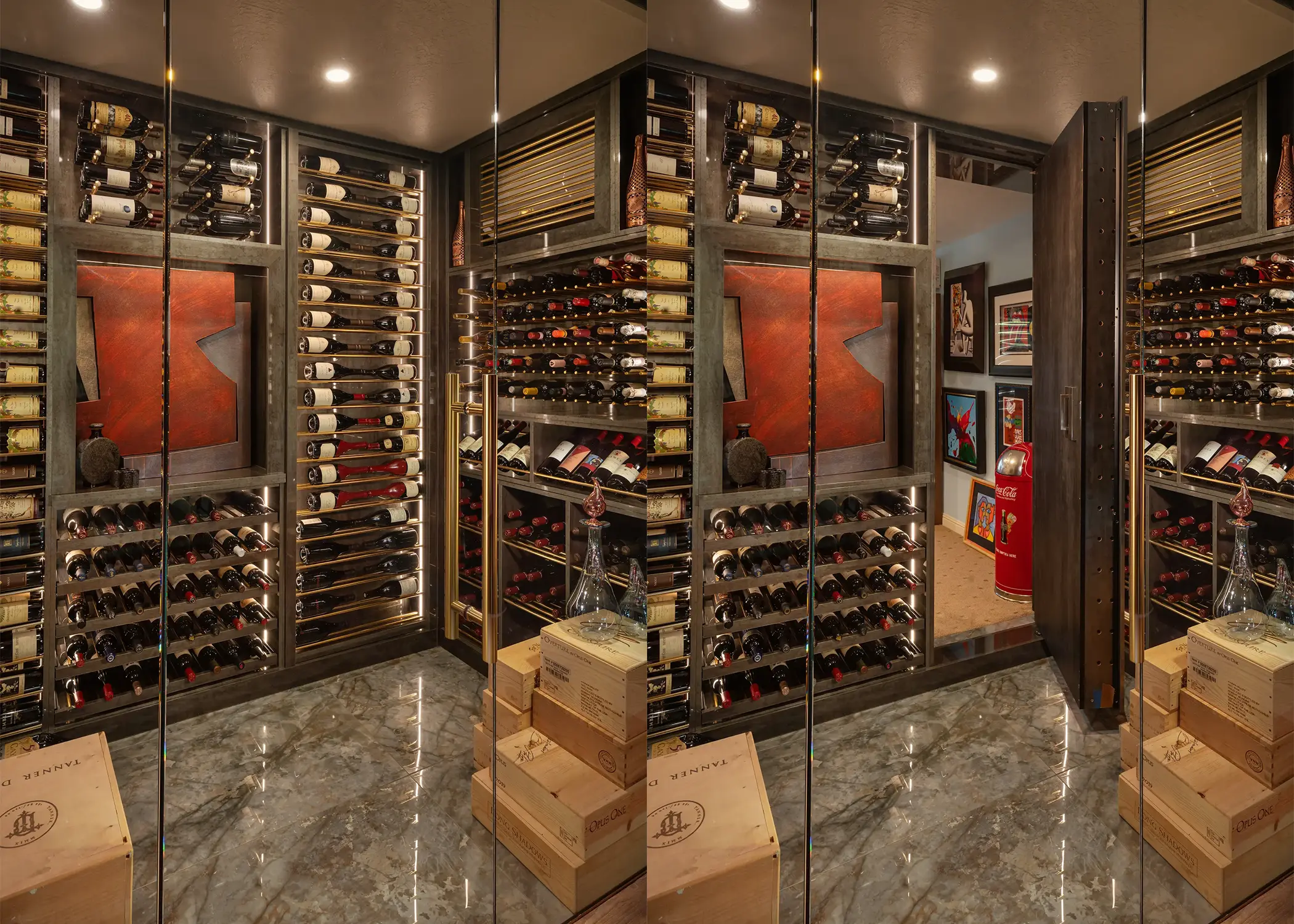
Glass enclosures have become the defining feature of contemporary wine cellar design, and the reason is straightforward. A glass cellar lets the bottles themselves become part of the visual composition of adjacent rooms, which means the collection feels present even when the door is closed. Floor-to-ceiling installations with minimal hardware, full-height pivot doors, and integrated lighting that washes the bottles top to bottom all contribute to a result that reads as a piece of architecture rather than a storage room.
The engineering reality of glass cellars is where most renovation projects either succeed or struggle. The right cooling system holds 55 - 62 degrees reliably through summer peaks. The wrong one fails its first August. This is the kind of detail that separates a project built by experienced wine cellar designers from one assembled by a contractor working through it for the first time.
2. Cable and Acrylic Display Systems for Contemporary Wine Cellars
Cable suspension and acrylic peg systems have transformed what is achievable in contemporary wine cellar designs. These systems hold bottles in place with almost no visible structure, which lets the labels become the wall. A relatively small footprint can hold a meaningful collection without feeling crowded, and the verticality of the system reads as gallery installation rather than storage.
Cable display works best when the room has the height to take advantage of what the system offers, when the lighting is engineered to highlight labels rather than hardware, and when the back wall has enough visual interest to support the display rather than competing with it. Done well, the result is the kind of space that performs in marketing photography and in person.
3. Transitional Cellars That Bridge Traditional and Contemporary Sensibilities
Many of the homes we work in were not built in a strictly modern idiom, and a fully contemporary cellar would feel disconnected from the rest of the architecture. Transitional wine cellar design solves this by combining warm finishes like wood and stone with the structural clarity and material restraint of modern design. The result reads as timeless rather than tied to a specific decade, which is genuinely useful when the goal is to create a space that ages well alongside the home.
Transitional cellars are particularly successful in renovations where the homeowner is converting an unused bar area, or an existing pantry or closet. The transitional palette gives the design enough flexibility to work with the surrounding architecture while still delivering the visual impact that makes the cellar feel like a destination.
4. Traditional Cellars for Collectors Who Want the Old World Reference
Some collections call for the kind of cellar that looks like it has always been there. Traditional wine cellar design draws on the language of European cellars: arched ceilings, brick or stone walls, and lighting that suggests candlelight rather than gallery wash. For homeowners building around a serious collection of Bordeaux, Burgundy, or aged Italian reds, a traditional cellar can be the right design answer because the room itself reinforces the character of what it holds.
The renovation considerations here include sourcing materials that read as genuinely aged rather than as imitation, handling the cooling requirements without visible modern equipment, and integrating storage density that respects the collection's organization without crowding the room's visual rhythm.
5. Wine Walls and Wine Closets as Right-Sized Alternatives
A full custom cellar is the right answer for many projects and the wrong answer for others. Homeowners with limited square footage, or those who want their wine to be part of the kitchen and dining experience rather than a separate destination, are often better served by a wine wall or a thoughtfully designed wine cellar. Wine walls integrated into kitchens, dining rooms, and living spaces have become one of the most requested renovation directions we see, because they offer the visual presence of a cellar without requiring a dedicated room.
The trade-off is honest. A wine wall is suited to working collections of 300-500 bottles or fewer, where the turnover is steady and long-term aging is happening elsewhere. For a collection in the multiple thousands, a dedicated cellar is still the right answer. The renovation question is which of those situations actually applies to your collection and your habits.
6. Commercial and Hospitality Cellars That Drive Guest Experience
Restaurants, hotels, and private clubs use wine cellars as part of the guest experience in ways that residential projects rarely have to consider. A commercial wine cellar has to handle service flow, sommelier access, capacity for both bottle inventory and wines being held for events, and the kind of visual presence that signals a serious wine program to guests the moment they walk in. The renovation conversations on hospitality projects start with operations and end with design, which is the reverse of how most residential projects move.
How Much Does a Custom Wine Cellar Renovation Cost?
The honest answer is that custom wine cellar renovation costs vary widely based on size, finish level, climate engineering complexity, and storage capacity. A wine wall or smaller wine closet renovation typically begins in the low five figures. A mid-size dedicated cellar with glass enclosure, custom racking, and full climate control commonly runs into the higher five and low six figures. Large custom cellars with traditional finishes, significant capacity, and integrated lounge or tasting space can move well beyond that.
What drives the variation is less about the bottles and more about the building. Glass enclosures, vapor barriers, custom millwork, and the cooling system specification together account for the majority of the budget on most projects. Racking is generally a smaller share than homeowners expect. The most reliable way to get a meaningful number for your specific project is to walk through the space with an experienced wine cellar designer who can assess the building envelope, the room's relationship to surrounding spaces, and the realistic cooling requirements before any pricing conversation starts.
What Is the Best Wine Cellar Refrigeration System?
The right wine cellar refrigeration depends on the size of the space, the insulation and vapor barrier quality, the heat load from glass and lighting, and whether the cellar is in a climate-controlled part of the home or somewhere with significant temperature swings. Through-wall systems work well for smaller cellars in stable environments. Ducted split systems handle larger spaces and offer quieter operation. Fully integrated mechanical solutions become necessary when the cellar is part of a complex layout, when noise has to stay completely out of adjacent rooms, or when redundancy matters because the collection is significant.
The principle that holds across every situation is that refrigeration should be specified after the building envelope is understood, not before. A correctly engineered cellar holds its conditions with a properly sized unit. An undersized unit in an underbuilt cellar fails. The order of operations matters.
Designing for the Long Run: What Tends to Go Wrong in Wine Cellar Renovations
The renovation projects that come back with problems usually share a few traits. The cooling system was specified before the room's thermal characteristics were fully understood. The vapor barrier and insulation was treated as an afterthought, which leads to condensation on cold surfaces and slow damage to finishes. Lighting was selected for visual effect without accounting for heat output and UV exposure. Racking was selected from a catalog rather than designed around the specific shape of the space. Each of these decisions feels minor at the moment it is being made, and each one tends to become the source of the call we get two summers later.
Local Considerations: Wine Cellar Design in Phoenix, Scottsdale, and the Southwest
Renovations in hot, dry climates carry challenges that many cellar designers underestimate. The thermal load on a cellar in Phoenix or Scottsdale during a 115-degree summer is structurally different from the load on a cellar in a temperate climate. Our team has built custom wine cellars across the Phoenix and Scottsdale markets specifically because the conditions here demand a higher level of engineering discipline than most regions require. The cellars that hold up in this climate are the ones that were designed for it from the first sketch.
Where to Begin Your Wine Cellar Renovation
The first step is rarely a sketch or a budget. It is an honest conversation about the collection, how the space will be used, what the rest of the home is doing architecturally, and what will still feel right ten or twenty years from now. The cellars that become the heart of a home are the ones where that conversation happens early and shapes everything that follows.
If you are planning a wine cellar renovation, our team is happy to walk through the project with you and help map out the design directions that fit your collection, your space, and your home. You can view our portfolio of recent custom wine cellar projects, explore our products and racking systems, or request a project consultation to start the conversation.